When Your Gut Takes the Wheel: Breaking the Cycle of Emotion-Driven Gambling
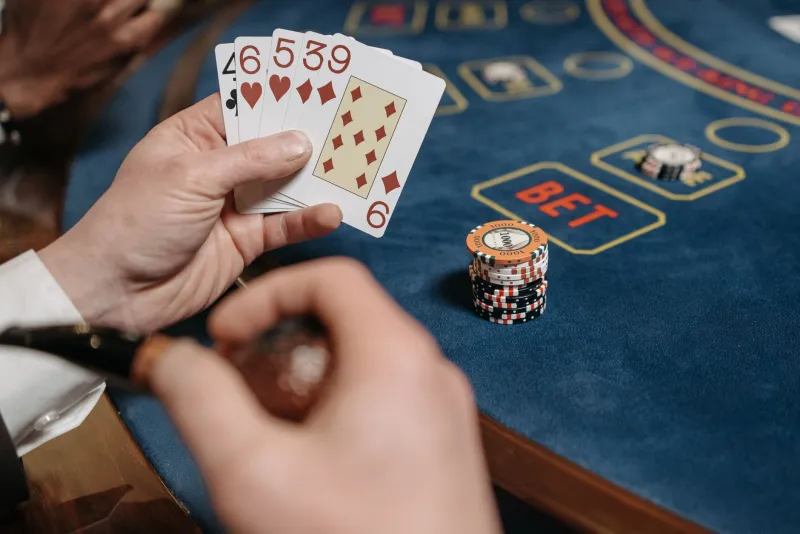
Here's a scenario you've probably lived through, or at least witnessed: a player drops a couple hundred bucks at the blackjack table, tells themselves they'll win it back with one more buy-in, and walks out three hours later wondering what the hell just happened. It wasn't a string of statistically impossible bad beats that cleaned them out. It was a feeling — frustration, pride, or something stubborn buried deeper than either — that kept them glued to that seat long after the math stopped making sense.
The house has a built-in edge on almost every game. But that edge is relatively small and predictable. What's not small or predictable is the extra damage players do to themselves when emotions take over the decision-making process. At Johnny Z's, we talk a lot about strategy and odds. Today we're going after something that doesn't show up on a pay table — the psychological traps that turn a bad session into a disaster.
Tilt: It's Not Just a Poker Problem
Most people associate tilt with poker — that moment when a bad beat sends a player into a spiral of reckless aggression. But tilt shows up at every table in the casino, and it doesn't always look like rage. Sometimes it's quiet. A player starts making slightly larger bets after a loss. They skip a decision they'd normally think through. They stop tracking time.
Tilt is essentially what happens when your emotional brain overrides your rational brain. Psychologists call this "affect heuristic" — using your current emotional state as a shortcut for decision-making. When you're running bad, your mind starts searching for any action that feels like regaining control. Bigger bets feel like control. Faster play feels like momentum. Neither is true, but your brain doesn't care about true right now — it cares about relief.
The first step in beating tilt is recognizing your personal tells. Do you start betting faster? Do you stop watching the other players? Do you skip the mental math you'd normally run? Those are your signals. Learn them before you need them.
The Revenge Bet: When the Casino Becomes Personal
Revenge betting is tilt's more dramatic cousin. It kicks in when a player stops thinking about expected value and starts thinking about settling a score — with the dealer, with the table, with the universe. The internal monologue sounds something like: "That pot was mine. I'm getting it back."
Here's the hard truth: the casino doesn't owe you anything, and it has no memory of what it took from you. Every hand, every spin, every roll is statistically independent of what came before. The deck doesn't know you're down $400. The roulette wheel isn't keeping score.
When you start framing losses as something to be avenged, you've already lost the most important battle — the one between your ears. Revenge bets almost always mean bigger wagers with less thought behind them. And bigger, impulsive wagers are exactly what a house edge loves to see.
A practical fix: before your next session, write down a maximum loss limit — not just a dollar amount, but a hard rule. "If I lose $300, I leave. Not after one more hand. I leave." Putting it in writing, even just in your phone's notes app, makes it a commitment rather than a suggestion.
The Sunk Cost Trap: Why Losses Feel Like Investments
Behavioral economists have studied the sunk cost fallacy extensively, and it shows up everywhere from business decisions to bad relationships. In a casino context, it sounds like this: "I've already lost $500 tonight. I can't leave now — I have to at least get back to even."
The problem is that the $500 is already gone. It doesn't matter whether you play one more hand or drive home right now — that money isn't coming back on the basis of what you've already spent. Your decision to keep playing should be based entirely on whether continued play makes strategic sense right now, not on what's already happened.
This is genuinely hard for the human brain to accept. We're wired to complete things, to balance ledgers, to finish what we started. Casinos are built around environments that amplify this instinct — no clocks, no windows, a constant sense that a turnaround is just around the corner. Recognizing the sunk cost trap won't make it disappear, but naming it out loud — literally saying to yourself, "This is the sunk cost fallacy" — can create just enough cognitive distance to make a better call.
Setting Emotional Anchors Before You Play
The best time to make rules about how you'll behave at the table is before you're at the table. When you're calm, fed, and nowhere near a casino floor, your rational brain is fully online. Use it.
Emotional anchors are pre-committed decisions that don't require willpower in the moment because they're already made. Here's a simple framework:
The Win Anchor: Decide in advance what a good session looks like. If you're up 40% on your buy-in, that's a win. Lock in a portion and give yourself permission to feel good about it.
The Loss Anchor: Set a hard stop-loss before you sit down. Make it specific — not "around $200" but "$200, period." When you hit it, the session is over. No negotiation.
The Time Anchor: Decide how long you're playing. Two hours, not "a couple hours." Set an alarm on your phone if you have to. Time distortion is real in casino environments, and giving yourself a hard endpoint removes one more decision from your emotionally compromised future self.
The Tilt Check: Build in a pause trigger. Something like: if I lose three hands in a row, I take a five-minute break, get some water, and ask myself honestly whether I'm still playing my game or somebody else's.
Self-Awareness Is a Bankroll Management Tool
Most casino strategy content focuses on the math — house edge, optimal play, bet sizing. All of that matters. But none of it helps if you're in a mental state where you're not actually using it. The most sophisticated blackjack strategy in the world doesn't save you if you're tilting into $100 side bets you'd never normally touch.
Think of emotional self-awareness as a layer of your overall game plan. It's not soft or psychological fluff — it's a concrete profit-protection mechanism. Players who can recognize when they're no longer thinking clearly and have the discipline to act on that recognition are playing with a real edge over players who can't.
Johnny Z has seen every type of player come through — the grinders, the high rollers, the recreational weekend crowd. The ones who consistently do the best over time aren't always the ones with the deepest strategy knowledge. They're the ones who know themselves well enough to walk away when the moment calls for it.
Your worst enemy at the casino isn't the house edge. It's the version of you that's been sitting at the table for three hours, down $400, absolutely certain that a comeback is one hand away. Build the guardrails now, while that person doesn't exist yet.